Hello Bunny: A Cheerful Handwritten Font for Modern Brands
There’s a quiet but profound moment at the start of any branding project. You open a new board, set your grid, and start pulling in type. The clean slate demands something more than just functional; it demands personality. I recently found myself in that exact moment for a visual refresh for a small, sunlit café. Their old identity felt tired, and they wanted something that spoke to warmth, community, and a handmade touch. After scrolling through endless fonts, I landed on Hello Bunny. It wasn’t just another option in the list; it was an immediate spark. Testing it on a simple logo concept, I typed out “The Daily Press” in this display font, and suddenly, the blank canvas had a heartbeat. The letters danced with a contemporary charm that was neither childish nor overly ornate. It felt exactly right.
What Makes Hello Bunny a Distinctive Display Font
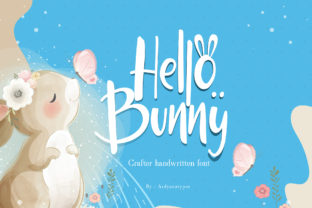
The product description calls it “cheerful and delightful,” and that’s precisely where its power lies. Hello Bunny is a handwritten display font with a dynamic style that avoids the cloying sweetness of some script faces. Its strokes have a confident, slightly uneven flow that feels authentic, not digital. When you look at it, you see the kind of handwriting you’d find on a thoughtfully crafted menu or a friendly neighborhood shop sign. Its “contemporary charm” comes from its balance—it’s playful but not silly, relaxed but not sloppy. This makes Hello Bunny incredibly versatile for projects that need to feel human and approachable. In my café mockups, it translated seamlessly from a logo lock-up onto a menu header, a takeaway cup label, and even the hero section of a website. Each application maintained a cohesive, warm brand voice.
Using Hello Bunny in Logo Design and Brand Identity Systems
A font like Hello Bunny often gets relegated to accent use, but I found it surprisingly robust as a primary logo font. For the café project, I drafted several logo variations. In one, “The Daily Press” stood alone in Hello Bunny, and it immediately conveyed a sense of personal craftsmanship. In another, I paired it with a clean, geometric sans-serif for the tagline “Coffee & Community.” The handwritten font became the emotional anchor, while the sans-serif provided structure and readability for secondary information. This is a key strategy: letting Hello Bunny carry the brand’s personality in headlines and logos, then supporting it with a more neutral typeface for body text. I extended this system to a brand board, applying the font to business cards, a loyalty card design, and even small social media icons. The consistency it offered was impressive; whether scaled up for a window decal or down for an Instagram profile picture, its character remained intact.
Hello Bunny on Packaging and Physical Brand Touchpoints
Perhaps the most telling test for any display font is how it behaves in the physical world. I mocked up a pastry box and a coffee bag for the café using Hello Bunny for the product name and key callouts. On the packaging, its handwritten quality evoked a sense of care and quality—the idea that what’s inside was made with attention. It didn’t fight with other elements like illustrations or color blocks; instead, it complemented them, adding a layer of human touch. On a business card, printed at a standard size, the font remained perfectly legible for the café name, though I wouldn’t use it for the tiny address and phone number details (that’s where your supporting sans-serif comes in). This is a crucial observation: Hello Bunny excels as a headline or accent font on packaging, labels, and signage, but it’s not designed for dense, small-point body copy. Knowing its lane is essential for professional use.
Integrating Hello Bunny into Digital Spaces: Websites and Social Media
Transitioning a handwritten font to digital environments can be tricky, but Hello Bunny’s contemporary style is built for it. Placing it in the hero section of a website mockup, as the main welcoming headline, it created an instant friendly connection. For social media graphics—think Instagram posts announcing a new blend or a weekend brunch—the font added a cohesive branded feel that stood out against the more generic templates often used. Its dynamic style gives it enough visual weight to anchor a graphic without needing heavy decoration. If you’re a blogger, content creator, or small shop owner, using Hello Bunny for your blog post titles or YouTube channel graphics could inject a consistent, personable vibe into your digital presence. It’s a font that feels social by nature.
When Hello Bunny Might Not Be the Right Font Choice
An honest review requires noting limitations. While Hello Bunny is a delightful and cheerful handwritten font, its very nature means it isn’t a universal solution. It would likely struggle in highly formal or corporate contexts—a law firm logo or a financial report headline would be mismatched. Its readability for long paragraphs is low, so it’s not a body text font. Also, for brands aiming for a minimalist, starkly modern aesthetic, the personality of Hello Bunny might be too pronounced. It’s best suited for projects where warmth, creativity, personal touch, and approachability are core brand values. Think boutique identities, creative studios, handmade shops, lifestyle brands, bakeries, cafés, children’s educational products, or any service that wants to feel like a friendly neighbor.
Practical Considerations Before Using Hello Bunny in Client Work
Before committing any font to a final client project, thorough testing is key. With Hello Bunny, I recommend:
- Creating mockups across all intended applications: logo, print materials, web, and social.
- Pairing it with at least two potential supporting typefaces (a simple sans-serif is often the safest, elegant companion).
- Checking its performance at various sizes, especially the smallest sizes you’ll use.
- Investigating the commercial license. Most fonts like this require a license for client work, especially if the final assets will be used in branding, packaging, merchandise, or digital products. Always confirm the license covers your specific use case.
Fonts are the voice of a brand. Hello Bunny offers a voice that’s unmistakably warm, contemporary, and genuine. In my testing, from that first blank brand board to the final packaged mockup, it proved to be more than just a decorative typeface; it became the core of a believable, engaging brand personality. For designers, entrepreneurs, and creators looking to infuse their projects with a cheerful and delightful human touch, this handwritten display font is a tool that can turn a concept into a character.